
The Four C’s: The Transformation That Got Finance to the Context Era

 15 Jul 2026


Key takeaways
- Most finance transformation strategies stall because they point generic AI at the data before grounding it in the business. The fix is context: AI that reasons from your chart of accounts, definitions, and governance.
- Compute, Comprehend, and Collaborate each made finance faster. Context is the fourth C, the one that makes AI trustworthy by tying the operating model’s five layers into a single loop.
- Your AI is only as reliable as the data beneath it, so start with the foundation. Pull your data into a single model, agree on what each metric means and who owns it, then build AI on top. Because the AI runs on that governed layer, it follows the same rules you’ve set, and every number it produces traces back to a source you trust.
- By standardizing on one governed platform first, Alltech cut its close from 20 working days to 12, automating 95% of intercompany eliminations with zero audit adjustments.
Most finance transformation strategies stall because they start in the wrong place. A team watches the demo, gets dazzled, buys the AI copilot, and points it at their data. Then the first real close arrives. The AI’s answers don’t reconcile with the actuals, no one can explain the gaps, and the rollout quietly gets shelved.
The technology itself is rarely what fails. The problem is generic AI never understood the business it was working inside, so its answers fell apart the moment they mattered most. AI-powered finance solutions need context to run on, and that context is the piece most strategies skip.
That gap is why we call this moment the Context Era. Look at today’s top finance teams, and you find the same thing beneath the AI: a deep well of context their AI can actually reason about.
Effective finance transformation strategies in the Context Era start with that missing piece, the context your numbers already live in. Get the context right, and every capability you layer on top inherits it.
Let’s look at how we got to today’s Context Era. First, we’ll see how four eras of computing brought us to the Context Era, why context is what makes AI trustworthy inside finance, and how it all connects to the new operating model for finance.
Learn more: The New Operating Model for Finance, Explained.
What are the Four C's of computing in finance?
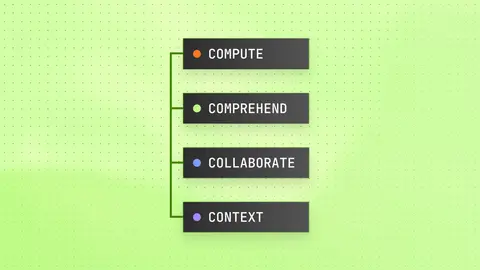
Four eras of computing brought finance here. Each one solved a real problem, and each set up the next.
- Compute gave finance raw speed. The spreadsheet replaced the calculator, and the math got faster.
- Comprehend taught machines to read, write, and summarize. They could classify a transaction or pull terms from a contract, or draft commentary on demand.
- Collaborate turned AI into a coworker. Agentic systems could take multi-step actions and complete tasks on the team’s behalf.
- Context plugs AI into your specific finance environment: your chart of accounts, entity structure, close calendar, forecasts, and governance.
Each era added something finance needed. Context adds the piece that makes the rest trustworthy, an AI that reasons about your specific business. That is why a serious finance transformation strategy now starts with context.
Why context is the unlock for AI in finance
Finance has rode wave after wave of new technology, each wave faster than the last. The Context Era adds the piece that ties all that capability to your business.
Context grounds AI in your distinct finance environment: your chart of accounts, your entity structure, your close calendar, and your governance. A generic tool reads your numbers, while an AI grounded in your context reasons about your business the way an analyst who has been on your team for years would. Its output holds up for an auditor, a board, or a regulator. That grounding is what turns AI into something finance can trust, and it is where every effective transformation starts.
This is also where the platform decision matters. An AI-powered solution purpose-built for finance, like Planful, runs on your context inside a governed, audit-ready environment. The AI inherits your definitions and controls rather than guessing at them.
How the Four C's connect to the new operating model for finance
Context is not an end in itself. It is the through-line that holds the new operating model for finance together.
Finance runs as a loop. The numbers your team produces get reviewed, the reviews shift your assumptions, and those assumptions shape your next forecast.
The new operating model gives that loop five layers:
-
- Your Foundation (your governed data)
- Your Intelligence (the signals you watch)
- Your Action (the work that produces the numbers)
- Your Feedback (how performance gets reviewed)
- Your Orchestration (the governance that keeps it all trusted)
Run these five layers on a shared context, and they behave like one system, where every cycle compounds on the last. Run them without it, and you have five disconnected workflows that rebuild the picture from scratch every month.
That is what the Four C’s have been building toward. Compute, Comprehend, and Collaborate have each made a part of finance faster. Context is what connects the layers, so the same definitions, ownership, and numbers carry through the whole loop. It is the reason the operating model works, and the reason AI inside it can be trusted.
What changes when finance runs on context
When the foundation holds, the change runs through every part of the finance loop. Cycles that once took days compress into hours. The numbers earn trust across the business because everyone works from the same governed source. Finance spends its time interpreting results and guiding decisions, with room for the analysis that moves the business forward.
This is where context-aware AI earns its keep. Within Planful, that looks like:
- Planful AI Analyst answers what-changed-and-why questions in plain language.
- Planful AI Signals flags anomalies the moment they cross a customizable threshold.
- Planful AI Planner generates projections and explores scenarios through chat.
- Planful Spotlight for Microsoft 365 delivers board-ready reporting in Excel, PowerPoint, and Word.
Each one works because the context beneath it is solid.
Start your finance transformation with the foundation your AI runs on
That foundation is your context, and building it comes down to three moves.
- Unify your data model. Get planning, close, and consolidations onto one governed source of truth, so the same number means the same thing everywhere. Planful runs Structured Planning, Dynamic Planning, Workforce Pro, and Consolidations on a single governed model and connects to your ERPs through hundreds of prebuilt connectors.
- Standardize definitions and ownership. Trace a recent close or forecast through your process and flag every point where context gets dropped, or a metric carries two meanings. Close the highest-impact gaps first.
- Layer context-aware AI on top. Once the foundation holds, AI inherits your definitions, governance, and lineage.
How Alltech cut 8 days from its close process
Alltech, a global leader in animal nutrition, grew through acquisitions until its finance team hit a wall. More than 200 accountants ran close and consolidation across 140+ legal entities in spreadsheets. Global consolidation happened only quarterly. The close averaged 20 working days.
Alltech standardized on one governed platform before adding anything on top. The results:
- 95% of intercompany eliminations automated
- Monthly consolidation, with a draft ready by working day seven
- Hard close completed by working day twelve
- Zero audit adjustments
“From day one, Planful had a really solid understanding of our day-to-day accounting life and what we need, rather than what IT or an engineer might think we need.” — May Xu, Deputy CFO, Audit and Reporting, Alltech
That understanding of finance is the point. A platform built for the function starts where your team already is.
Get your field guide to how today’s top finance teams actually run.
Read The New Operating Model for Finance, Explained.
FAQs
What are the Four C’s of finance transformation?
Compute (raw speed), Comprehend (machines that read and classify), Collaborate (agentic AI that takes multi-step action), and Context (AI grounded in your specific finance environment).
What is the Context Era?
The Context Era is the shift to AI that reasons from your governed finance data instead of generic data. It works from your chart of accounts, your definitions, and your controls. It is what makes AI output reliable enough for an audit, a board, or a regulator.
How do the Four C’s connect to the new operating model for finance?
Context, the fourth C, is the through-line that connects the operating model’s five layers (Foundation, Intelligence, Action, Feedback, and Orchestration) into one loop. Compute, Comprehend, and Collaborate each expanded what finance could do. Context ties them together so each cycle compounds on the last.
Why do effective finance transformation strategies start with context?
Because AI in finance is only as reliable as the context beneath it. With shared definitions, ownership, and lineage in place, AI produces answers that hold up through an audit. Context is what makes the rest of the transformation hold.
Latest Posts
Blogs
Interviews, tips, guides, industry best practices, and news.
Get Started with Planful
- How much time will you save?
![LinkedIn]()
- How will your finance team evolve?
![LinkedIn]()
- Where will technology support you?
![LinkedIn]()

